For most engineers, computational metamaterial design has been out of reach. Generating a gyroid scaffold or a spinodoid foam, homogenizing its mechanical response, and exporting it for 3D printing has historically required a high-performance compute cluster, a six-figure software license, and a specialist trained to drive both. None of these is unreasonable on its own. Together, they make computational design a gated discipline, accessible only to organizations that can absorb the overhead.
F13LD is a counterexample. It is a suite of nine browser-based tools that runs on consumer hardware, exports manufacturable geometry, and answers most of the questions that enterprise tools are asked. This piece is the reference: what each tool does, how the pieces fit together, and where to start.
Design — generate scalar field recipes
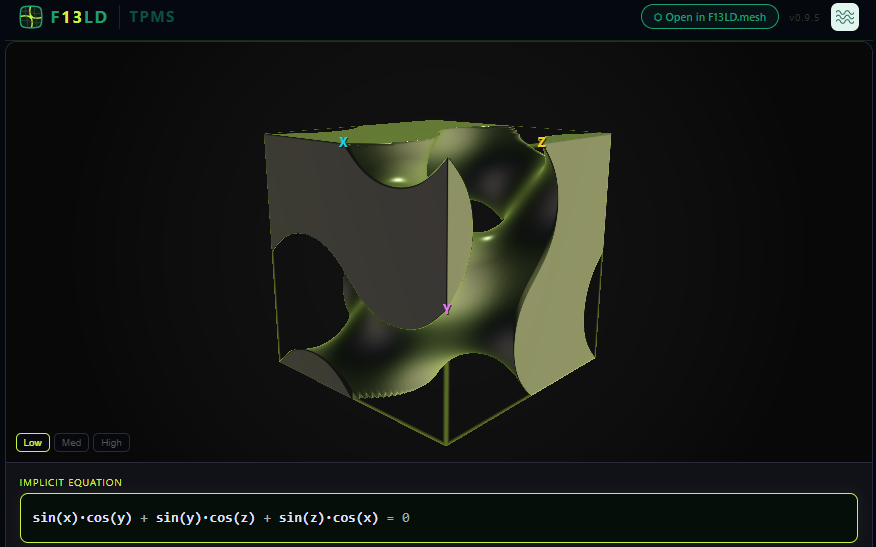
TPMS (tpms.f13ld.app). Triply periodic minimal surfaces — gyroid, Schwarz primitive, diamond, IWP — and the parameterized phase intersection family (PI-TPMS) that extends them. Real-time WebGL raymarching previews the surface as cell scale and isovalue change. TPMS is the workhorse of implicit geometry: smooth, manufacturable, well-characterized. Reach for it when periodicity is acceptable and the load case is roughly isotropic.
Noise (noise.f13ld.app). Procedural noise fields — simplex, Worley, billow, curl — used as the underlying scalar function for an implicit lattice. Set an isovalue, render the level set, get a non-periodic structure with the spectral character of the noise type. Simplex yields soft, isotropic surfaces; Worley produces cellular patterns that resemble closed-cell foam; billow generates puffy, cloud-like volumes; curl produces swirling, divergence-free flow patterns. Noise is the right tool when the design problem rejects periodicity but the structure should still be deterministic.
Grain (grain.f13ld.app). Stochastic scalar fields — spinodoids, Gaussian random fields, hyperuniform packings, Gray-Scott reaction-diffusion. Same isosurface trick as Noise, but the underlying field is generated by a physical process: phase separation, correlated randomness, repulsion-driven point distributions, or two-component reaction kinetics. The output structures are non-periodic and non-deterministic — they are samples from a distribution. Grain is the right tool when the design intent is a class of structures rather than a specific one.
Beam (beam.f13ld.app). Beam lattices — the strut counterpart in the F13LD suite. Octet, Kelvin, body-centered cubic, face-centered cubic, and stochastic Voronoi networks. Beam lattices have well-understood mechanics and decades of literature; they are the structures most existing FEA tools were built to handle. F13LD's Beam tool generates them as implicit fields too — an SDF of unioned cylinders — so they pass through the same downstream pipeline as everything else.
Bundle — helical, woven, and braided fiber structures — is in development and not yet released. It will join the Design column when it ships.
Pipeline — sweep, ingest, store
Sweep (sweep.f13ld.app). Parameter space exploration. Feed Sweep a recipe — a TPMS gyroid, a spinodoid from Grain, a Voronoi beam network — and it generates the family of variants across that recipe's parameters automatically. The user picks three filters; each generated recipe plots as a point in the 3D space those filters define. The output is not a single design but a navigable cloud of designs, each with its own homogenized properties. This is how you find the structure that matches a target stiffness or compliance, instead of guessing once and accepting the result.
Ingest (ingest.f13ld.app). The gatekeeper between sweep output and the Vault. Every candidate structure is checked for physics plausibility — non-negative stiffness, achievable manufacturability, no degenerate geometry — deduplicated by content hash, and batched into the database. Ingest is the only tool in the suite that exists to reject designs. Its job is to make sure the Vault stays trustworthy as it grows.
Vault (vault.f13ld.app). The structure library. A searchable database of verified geometries with their homogenized properties: anisotropy, full stiffness tensor, achievable density range, diffusion coefficient, tortuosity, connectedness, and manufacturing tier. Filter by application domain, by target property range, by source tool. Match scoring is range-normalized so different property scales compete on equal terms. The Vault is the suite's memory — the accumulated record of what has been generated, characterized, and certified for downstream use.
Inverse — target → recipe
Synth (synth.f13ld.app). Inverse design. The other design tools take parameters and emit structures; Synth takes a target — a desired stiffness tensor, a target anisotropy ratio, a density-stiffness operating point — and emits the parameter recipe that produces it. It is a model trained on the Vault, which means it knows exactly what the Vault knows: nothing more, nothing less. Within the curated families, it answers the question every metamaterial designer actually wants to ask: given this load environment, which structure should I print? The forward tools answer "what does this parameter set produce." Synth answers "what parameter set produces this."
Export — geometry to manifold mesh
Mesh (mesh.f13ld.app). The sink. Mesh accepts a JSON recipe from any tool that produces a design — TPMS, Noise, Grain, Beam, Sweep, Vault, or Synth — applies optional SDF transforms (rotation, offset, isovalue adjustment) for fit-up against a target part, and emits a watertight 3MF mesh at user-selected resolution. The meshing path runs through Manifold's levelSet implementation, which guarantees a single closed surface — no orphan triangles, no manifold violations, nothing that will fail a slicer.
Mesh is the only tool in the suite that emits files. Everything else emits recipes.
The unifying philosophy
Every tool in the suite is a single HTML file. Open the URL, the tool runs. There is no install, no account, no cloud sync, no telemetry. The page loads, your hardware does the work, and your designs live on your machine until you choose to upload them. WebGL2 handles real-time rendering; WASM handles the heavy math. Every dependency loads from the public web — the same servers that host any modern site. The source of every tool is a single readable, forkable HTML file.
A shared JSON schema connects them. A design generated in TPMS, Noise, Grain, Beam, or Synth is the same kind of object — a recipe for a scalar field plus its metadata — and any tool that consumes designs can consume any of them. The geometry stays implicit from generation through transformation; only at the Mesh export step does it commit to triangles.
A tool, in two minutes
Open tpms.f13ld.app. Pick "Gyroid" from the surface family menu. Adjust the cell scale until the structure looks right at the size you want to print. Click Open in F13LD.mesh. Pick your resolution. Download the 3MF. Two minutes from a cold tab to a sliceable file. From there: try a different surface, try a different design tool, save a result to the Vault, ask Synth for a structure that matches a target stiffness. The suite is designed to reward exploration.
Each tool fits in a browser tab. Everything else follows from that.